

Publications
Peer-reviewed papers and policy reports. The full back catalogue is on Google Scholar.
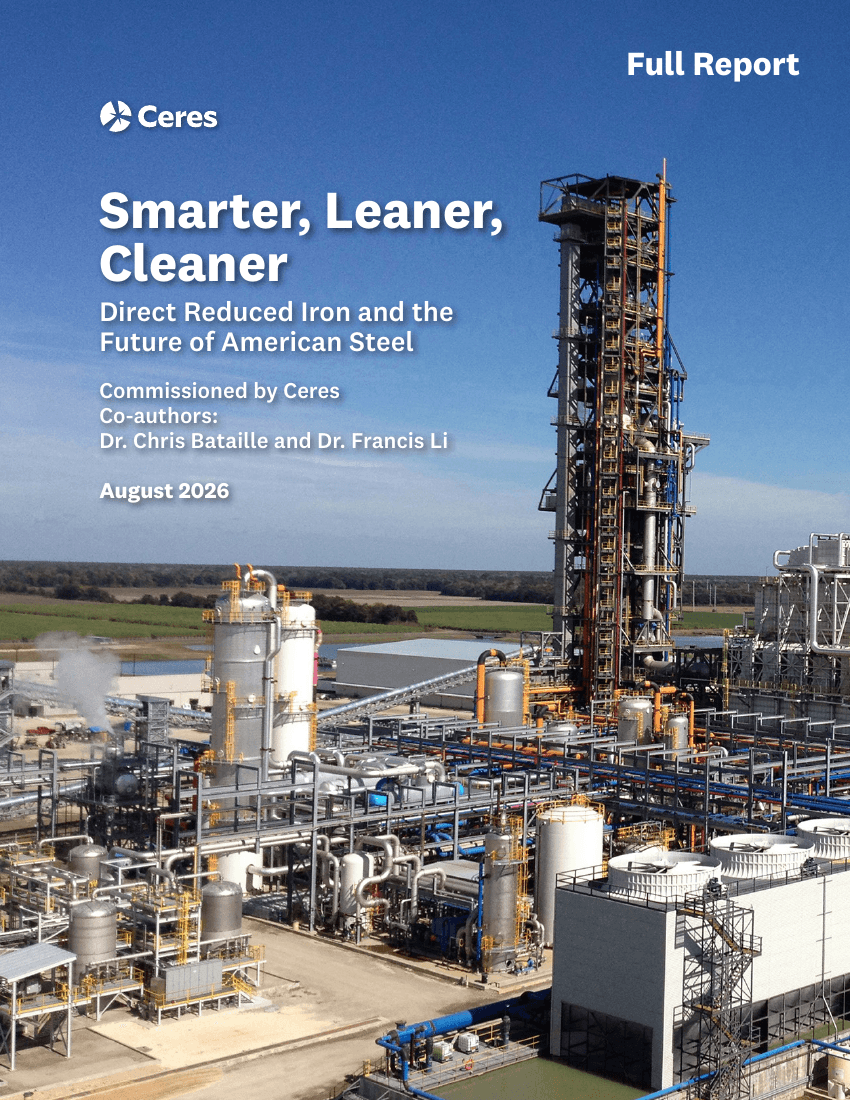
Smarter, Leaner, Cleaner: Direct Reduced Iron and the Future of American Steel
August 2026Ceres · Commissioned report
A regional techno-economic assessment of direct reduced iron in the United States, written for the moment when the country's aging blast furnaces and coke ovens come up for reinvestment. It compares new-build pathways across four ironmaking regions, Minnesota's Iron Range, the Gulf Coast, Pennsylvania and Northern Indiana, on the terms that actually decide what gets financed: the cost of raw materials, energy and equipment, transport, and the alternatives available locally. Input prices are run across plausible ranges rather than single best-guess figures, so each option is judged under both favorable and unfavorable conditions. The conclusion is about investment timing rather than headline cost. Gas-based DRI is the lowest-cost new-build option in every region modeled and clears the rate of return investors look for at current US steel prices, which makes it the strongest home for the next dollar of new capital.
Read the report
Guidelines for Decarbonizing Industry in Time to Meet Global Climate Goals
April 2026Center on Global Energy Policy, Columbia University SIPA · Policy report
A global assessment of how fast heavy industry has to decarbonize to keep the Paris targets within reach, and what that asks of policy and investment. The headline is stark: the pace has to roughly triple, every new plant in advanced economies and China needs to be near-zero by 2030, and the carbon prices and capital required run well beyond today's. It lands as a set of practical guidelines for governments, industry, and finance.
Read the report
Technology and policy options for achieving net zero steel manufacturing in the United States
January 2026Energy Policy, vol. 211, art. 115124 · Peer-reviewed
This peer-reviewed study asks what it would take for US steel to reach net zero by 2050, and answers with IndustryPath, the Subtext Systems facility-level model spanning thousands of plants worldwide, rather than a single national average. Its central finding is that the United States could be among the first countries to decarbonize steel with technology that already exists, but how fast that happens, and where the capital lands, depends heavily on how open US trade policy stays. The paper is direct that support policies like the Inflation Reduction Act will not carry the transition on their own, and that demand-side and trade measures have to do part of the work.
Read the paper